
The 5 Most Common Interview Mistakes (And What To Do Instead)

Did you know that job openings get a huge response, but only 4-6 candidates get shortlisted for an interview?
Getting nervous before an interview is one of the most common feelings.
Things get more serious when candidates realise that the hiring managers make the hiring decision within the first 5-10 minutes!
Here is the fact: A job interview is your first interaction with the employer.
Before that, you have communicated with them through a document such as a great resume written by CV writers NZ.
But this one opportunity is your chance to show who you are.
And one small mistake during the interview can reverse a positive decision into something you don’t want to hear!
So keep reading to discover the most common interview mistakes and practical ways to avoid them.
The Importance Of Being Aware Of The Interview Mistakes
Interviews are often intimidating. A highly qualified professional with years of expertise might have the most impressive resume.
But when it comes to answering common interview questions? They might get confused as well. This is what happens with most of the candidates.
Despite their proficiency in a certain field, they avoid to learn about the common mistakes that cost them the job.
Take a preview of the most typical pitfalls that occur during an interview.
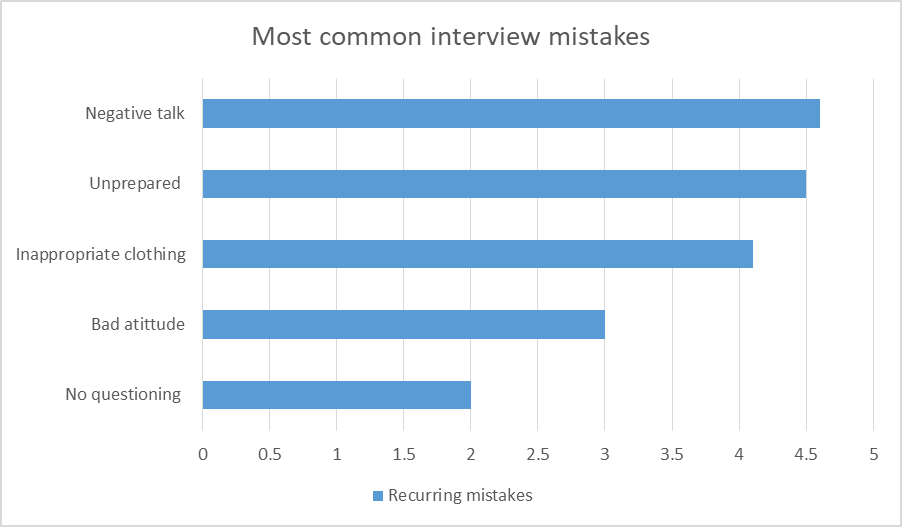
This is the reason presenting yourself the right way during an interview is important. The hiring managers have a keen eye for aligning your resume with your personality.
They want to see if the words actually justify who you are.
However, any of these mistakes (or more) could shrink your chances of getting hired.
Five Most Common Errors Candidates Make During An Interview
Getting an interview call is one of the biggest achievements.
You have passed the initial stages, and you are one step away from landing your dream job role!
But here is the problem: one mistake occurs during the interview, and you are sent back home. No job offer call. Nothing.
Let’s dive deeper into the five common mistakes to avoid during a job interview.
1. Going Unprepared
According to professional interview tips, over 47% of candidates are rejected because they haven’t done proper research on the company.
This is one of the biggest mistakes candidates make.
Too many of them ignore the need for preparation. They believe that they will naturally speak in front of the employers. This is what doesn’t happen.
Employers expect you to do the homework. They want you to be informed about the company.
Here is why it happens:
| Time issues | Candidates fail to manage time properly for reviewing the job description. |
| Overconfidence | Many of them assume that they know everything. |
| Non-serious | Candidates consider an interview as a random conversation. |
However, this attitude ruins it all for them because the recruiter actually wants to know about,
- Your understanding of the company’s objectives
- The reason behind joining this role
- How your skills align with the job role
- Detailed examples of how you completed a task
- Why are you considering the company
Blank faces instantly disappoint the recruiter. They don’t want to hire someone who hasn’t invested their time in knowing about the company.
Here is what you should do instead,
Preparation isn’t only about memorising the data on your resume or noting points about the company’s history.
It includes,
| Tailoring responses | Make sure every answer is tailored to the company’s goals. |
| Researching | Research the company’s mission, vision, values, products, and culture. |
| Reviewing description | Understand the job responsibilities, expectations, and requirements. |
| USP’s | What do you think is unique about them, and why do you want to apply for the role? |
Furthermore, you can also choose to practice in front of the mirror. Think about all the common questions in your mind, and start preparing!
Pro tip: Preparation isn’t only about how you are going to act in front of the employer. It also comprises planning your route, where you are going where and other details. Make sure to figure out everything in advance for perfect outcomes!
2. Complaining About The Past Employer
In your previous job role, your boss might be the controlling one, or the environment might be extremely toxic.
Worst-case scenario, they didn’t clear your dues and treated you terribly.
But you don’t need to mention them, neither in your CV Auckland NZ, nor during the interview.
Each of these behaviours is wrong.
How they behaved with you was unfair. But remember, bringing this to your current interview will only cause you more loss!
Many candidates assume that spilling negative facts about their previous employer is going to benefit them. But here is the truth: It won’t!
Instead, it forms a wrong perception about you.
Here is why,
- The hiring manager might think that you are the problem
- They may consider you emotionally immature
- Your image may appear as unprofessional
- They will assume you are going to badmouth them, too
Remember, your last job might have caused a lot of loss. You shouldn’t let that happen again!
Even if you are being honest, it will still be perceived as a red flag by the employer.
Here is what you need to do instead,
- Don’t give too many details about the previous employer
- Use a neutral and professional tone while talking about your experiences
- Focus on what you learned with them
- Show your problem-solving skills
- Emphasise self-awareness and your growth points
This shows the employers that you are willing to spread positivity. It highlights your conflict resolution skills and ability to work well with other colleagues.
3. Talking Too Much Or Less
Striking the balance between talking too much or too little is important. You need to remember that an interview is a formal conversation.
However, many candidates make this one common mistake of waffling or getting confused.
According to professional CV writers NZ, here is what happens with too much speaking,
- A candidate starts to repeat information
- They drift away from the main point
- It takes them long minutes to answer a short question
- The presentation of unstructured thoughts occurs
Moreover, people who speak a lot are often considered poor listeners.
This means, expressing this trait would negatively affect your teamwork skills. It will represent that you cannot work in a team, something you don’t want to happen!
On the other hand, when you talk less and give cliché responses like,
- I’m a great learner
- I work hard
- I’m a good leader
These are considered buzzwords. The employers are aware of these generic terms and might fail to explain your skills the right way.
However, the appropriate way is to highlight your skills using the STAR method. Backup each claim by presenting your achievements and milestones.
Pro tip: Remember to use the same approach in your resume as well. If you are struggling to refine your achievements into compelling narratives, you can choose to work with CV specialists in Christchurch.
| Situation | Describe the background and context of the scenario. |
| Task | Highlight your responsibilities or the challenge you overcame. |
| Action | Detail the action you took by specifically highlighting your skills. |
| Result | State the outcomes, quantify the results to leave a strong impact. |
4. Not Asking Questions
Many candidates assume that answering questions is enough for a successful interview.
They hesitate because of the
- Fear of sounding inexperienced
- Lack of preparation
- Low confidence
- Nervousness
However, what they forget is that they are being analysed by the recruiter.
The hiring manager wants to assess their thinking capabilities. Staying quiet is just a sign of your disinterest, nothing else.
It signals your disinterest or lack of enthusiasm for the role despite the submission of a well-written resume from CV writers NZ.
However, questioning properly shows your strategic thinking skills. It tells the employer that you are curious about the role and more than excited to join as well.
Here is what you can ask,
| Culture | Tell me more about the company culture |
| People | What are some of the qualities of your employees? |
| Expectations | What is the definition of success in your company? |
| Dynamics | How is the feedback given in your team? |
| Growth opportunities | What are the opportunities for learning new skills? |
Think about 5 questions like this. Preparing your questions and asking them at the right time can demonstrate your interest and long-term thinking skills.
5. Showing a Bad Attitude During The Interview
You might be the perfect fit for the role, but one thing could stop you from getting hired. That is, an absence of a positive attitude.
The way you behave during an interview matters the most.
A bad attitude is not always about being rude. It also includes,
- Showing no respect to the employer
- Not maintaining eye contact
- Showing irritating behaviour
- Acting as if you were bored
- Lack of attention
- Bad posture
If an employer notices any of these behaviours, they will instantly notice that you might be a problem to work with.
They will fear that you will,
- Lower morale on the team
- Participate in conflicts or drama
- Resist growth opportunities
- Give a bad influence on the employees
Here is what you need to do instead,
| Be polite | Nod while listening, avoid interrupting, and be thankful for the interviewer’s time. |
| Be curious | Show excitement and ask questions. It demonstrates enthusiasm. |
| Learn | You don’t need to be a pro at everything. Just show your willingness to learn. |
| Stay calm | Interviewers test your reaction. Answer respectfully and logically to the recruiter. |
| Feedback | Give a positive response to feedback. Show how you are willing to improve. |
Just remember, confidence is great, but overconfidence is not!
A bad attitude will reflect arrogance, ultimately decreasing your chances of getting hired.
Wrapping Up
Thinking about your first interview might feel daunting. But this is the one phase that will finalise the hiring decision. Common interview mistakes are a hurdle, but only until you are unaware of them. Since you are now fully familiar with them, you can easily turn your interview into an opportunity to begin your dream career! Remember, you don’t need to be perfect during an interview. Just get an exceptional resume from CV writers NZ, be authentic, and execute the strategies above; this is what matters.
FAQS
1. How early should I arrive for the interview?
Arriving 10-15 minutes before the interview is the ideal time. Showing up earlier may look very desperate, and arriving late will indicate a careless and disorganised behaviour.
2. Should I talk about the salary in the interview?
Salary conversations are only acceptable when the employer initiates them. First interviews are mostly about analysing your personality and discussing the company culture. Salary talk usually comes after you receive the offer.
3. Should I send a follow-up message after the interview?
Yes! Sending a follow-up message after 24 hours of the interview will demonstrate your professionalism and eagerness to join the company. Don’t forget to add that personal touch by highlighting something specific that you discussed with the employer.

I am a registered career expert and New Zealand market specialist with over 15 years of experience in vocational coaching. I help Kiwis across Auckland translate their professional journeys into job-winning documents. By focusing on measurable results and the ‘CAR’ (Context, Action, Result) method, I write informative blogs needed to navigate the local job market with confidence.